
eXcel: Why Meaningful Excellence Requires Discipline, Measurement, and Continuous Evolution?
In the previous ALEX Principles reflections, I shared why growth begins with aspiration, why leadership is more than title or authority, and why empowerment helps people and organizations multiply impact.
But eventually, aspirations, leadership, and empowerment need to create something tangible.
Progress. Execution. Improvement. Meaningful outcomes.
Because without execution, even the most inspiring vision remains only an idea.
That is why the final ALEX Principle is: eXcel.
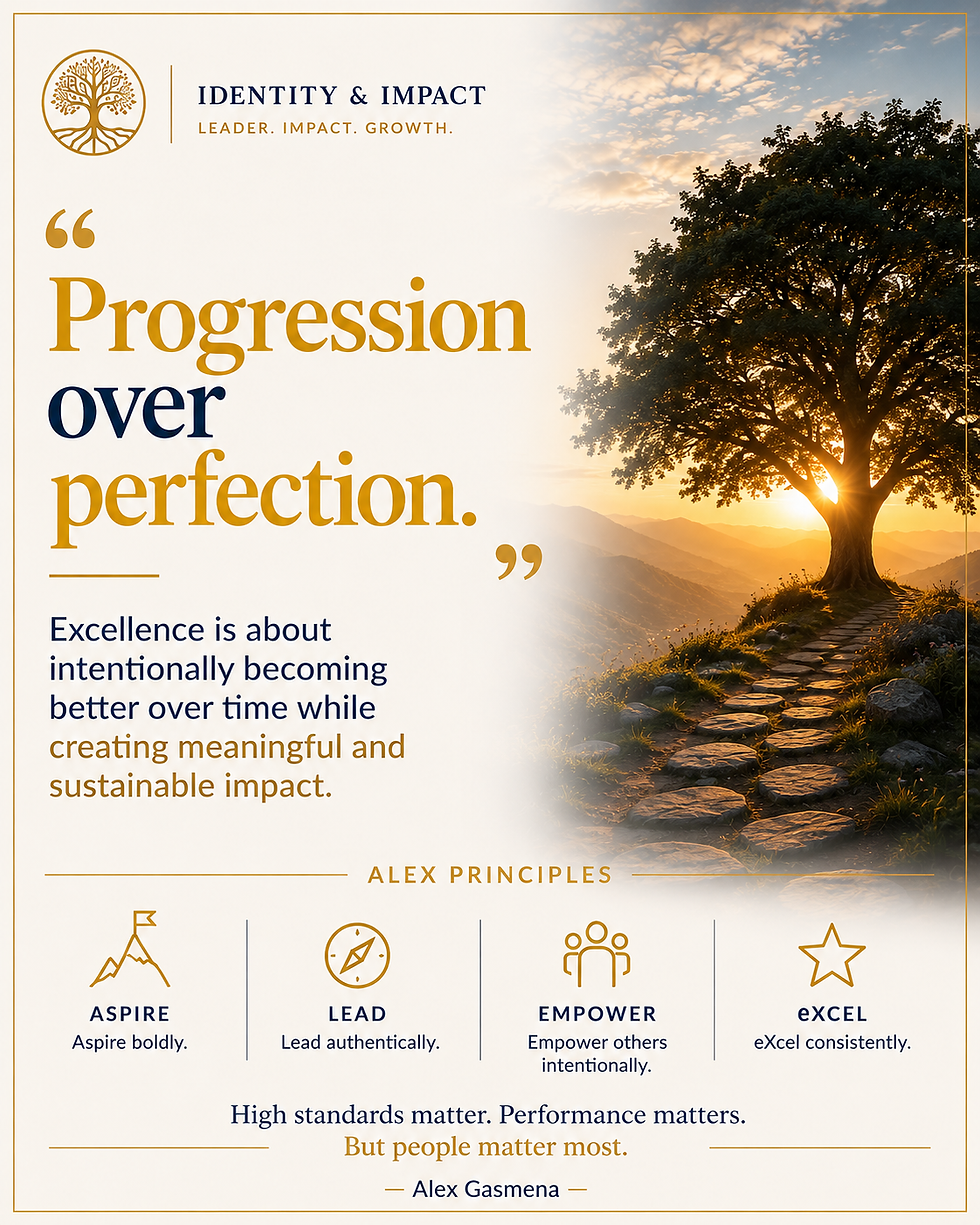
Over the years, I’ve also noticed that excellence is often misunderstood. Many people associate excellence with perfection or relentless pressure. But personally, I do not believe excellence is about perfection. In fact, one phrase I often say is: “Progression over perfection.”
And another belief I strongly hold is: “What you cannot measure, you cannot achieve.”
Because excellence is not about becoming flawless. It is about intentionally becoming better over time while creating meaningful and sustainable impact.
As Peter Drucker famously said: “What gets measured gets managed.”
At a personal level, excellence requires more than ambition. People eventually need:
clarity,
measurable goals,
accountability,
discipline,
feedback,
and continuous learning.
Dreams become significantly more powerful once they are connected to concrete actions, milestones, and measures.
It is one thing to say: “I want to grow.”
It is another thing to define:
what growth specifically looks like,
what success will be measured against,
what capabilities need strengthening,
and what timeline creates accountability.
One experience that deeply shaped my understanding of excellence happened when I joined Accenture early in my career. At that time, I intentionally set a goal for myself:I wanted to develop into a global HR professional within five years. Very quickly, I understood that aspiration alone would not make that happen. I needed deliberate preparation, measurable development, strong execution and visible results. So I made my goal known to my leaders early on. But more importantly, I ensured that every assignment entrusted to me was delivered with strong quality and consistent performance. At the same time, I invested heavily in learning beyond my immediate responsibilities. I researched what experiences and capabilities were needed to eventually qualify for global opportunities. And when an opportunity emerged to help design and support Accenture’s Global Careers Program, I volunteered immediately.
But volunteering alone was not enough. I also intentionally developed skills and knowledge areas that I believed would prepare me for larger global responsibilities, including:
global mobility and international assignment management,
finance concepts such as loaded cost rates, cost modeling, taxation,
stakeholder management across cultures,
executive communication,
presentation and facilitation,
process improvement and operational excellence,
and large-scale program management.
I also accepted the opportunity to relocate and work in the United States for several years to deepen my exposure further. Over time, that program became highly successful and impactful across the organization. In fact, to my knowledge, the program still continue to exist today.
That chapter of my career taught me something important very early on: Strong outcomes rarely happen accidentally. They are often the result of preparation, curiosity, disciplined execution, continuous learning, and the willingness to stretch beyond familiar territory.
At the team level, excellence becomes even more important because teams require focus and operational clarity to perform consistently. One operational excellence approach I strongly believe in is what I call the “3x3 metrics” method. The concept is intentionally simple. Instead of overwhelming teams with endless reporting and measurements, identify only:
the top 3 critical output metrics directly connected to business outcomes and enterprise strategy,
and the top 3 key input metrics that most strongly influence those outcomes.
For example: Output metrics may include revenue growth, cost savings, profitability, customer satisfaction, employee experience, adoption rates, operational turnaround time, productivity improvement, or quality performance. While input metrics may include training completion, staffing readiness, process compliance, system adoption, backlog health, manager effectiveness, operational capacity or knowledge management quality.
The purpose is not reporting for reporting’s sake. The purpose is creating visibility, focus, operational discipline and meaningful conversations around performance and improvement.
Experience eventually taught me that when organizations attempt to measure everything, teams often lose alignment and clarity. But when people rally around a few meaningful measures connected directly to outcomes, accountability and execution become significantly stronger.
And this is exactly why I often remind teams: “What you cannot measure, you cannot achieve.”
One experience that strongly reinforced this belief happened in a previous organization where I implemented a highly disciplined operational excellence culture across teams. Each team conducted daily operational huddles focused on priorities, operational risks, improvement opportunities and their 3x3 metrics consistently. And importantly, the discussions were never meant to become repetitive reporting routines.
The conversations focused on questions like:
What is the data telling us?
Where are problems emerging?
What improvements can still be made?
What standards can now be raised further?
I also regularly conducted floor walks — including surprise ones — where I engaged teams directly around operational performance, customer outcomes, unresolved issues, and opportunities visible in the data.
Over time, this discipline created a very strong culture of ownership, accountability, operational awareness, and continuous improvement. And the impact became highly visible. The organization generated millions in annual savings, significantly improved operational performance, and many of our teams were eventually showcased to external clients as examples of operational excellence and transformation capability. In fact, those demonstrations helped the organization secure and expand additional client work.
Moments like that reshape how you think about excellence. Operational excellence is not built through presentations or strategy slides alone. It is built through disciplined execution, visibility, leadership engagement, operational rhythm, and continuously challenging teams to improve beyond current performance levels.
At the organizational level, excellence becomes even more critical because organizations now operate in environments that are fast-moving, highly competitive, global and increasingly data-driven.
And one principle I strongly believe in is this: Metrics should always connect meaningfully to business outcomes and enterprise strategy.
Too often, organizations measure activity instead of impact. They measure volume instead of value. Or they create dashboards that appear impressive but do not genuinely improve:
customer experience,
operational effectiveness,
innovation,
employee engagement,
profitability,
or strategic growth.
True organizational excellence happens when measures help organizations make better decisions, improve experiences, identify risks earlier, allocate resources more effectively and continuously adapt. And importantly, once performance targets are consistently achieved over sustained periods — for example, across two consecutive quarters — leaders should ask a critical question: “What is the next level of performance and improvement we should now pursue?”
Because excellence cannot become complacency. Organizations and individuals that stop evolving eventually become vulnerable to stagnation and disruption. As Aristotle once said:“We are what we repeatedly do. Excellence, then, is not an act, but a habit.”
The longer I work across transformation and operational environments, the more I appreciate that sustainable excellence matters far more than temporary overperformance. Because organizations can sometimes create impressive short-term results while quietly exhausting their people in the process.
And eventually burnout, disengagement, unhealthy cultures and declining innovationbegin undermining long-term success.
That is why sustainable excellence should not simply ask: “How do we produce more?”
It should also ask: “How do we improve while still allowing people to grow, recover, innovate, and remain human?”
Modern organizational research increasingly points toward similar conclusions.
One study that resonated with me came from McKinsey & Company discussing how long-term organizational success requires balancing performance outcomes with organizational health and continuous improvement.
This perspective also aligns closely with findings from Harvard Business Review highlighting that high-performing teams typically create clarity, measurable goals, accountability, trust and learning cultures that continuously evolve.
Across many of the strongest organizations I’ve observed, the pattern is remarkably similar aspiration, leadership, empowerment, disciplined execution and sustainable improvementall work together.
At a personal level, excellence requires consistency, self-awareness, accountability, learning and resilience.
At a team level, excellence creates operational rhythm, ownership, alignment, execution discipline and continuous improvement.
And at an organizational level, excellence shapes culture, competitiveness, innovation, adaptability and long-term sustainability.
Even today, I still find myself reflecting on this: Excellence is not a finish line.
It is an ongoing cycle of aspiring, leading, empowering, measuring, improving, learning and evolving.
And perhaps that is why the final principle is intentionally written as: eXcel.
Because excellence is not simply about maintaining standards. It is about continuously expanding what is possible. That, for me, is excellence.
eXcel.
Because people, teams, and organizations rarely sustain greatness by accident. It usually happens through intentional vision, disciplined execution, meaningful measurement, continuous improvement, and sustainable growth over time.
And with this final reflection, the ALEX Principles journey comes full circle:
Aspire.Lead.Empower.eXcel.
Over the next few weeks, my blogs, videos, and podcast conversations will begin shifting from philosophy and reflection into more practical methodologies, frameworks, and coaching discussions focused on how people, teams, and organizations can actually implement the ALEX Principles in real life.
We’ll begin exploring:
aspiration and vision-setting exercises,
leadership and executive presence development,
empowerment and succession-building frameworks,
operational excellence methodologies,
transformation execution,
meaningful metrics,
and sustainable performance practices.
And importantly, these discussions will focus on applying the principles at three levels: for oneself, for teams, and for organizations.
My hope is that Identity & Impact becomes more than just a collection of reflections, blogs, or videos. I hope it becomes a space where people, teams, and organizations can reflect honestly, challenge themselves, grow intentionally, and create meaningful impact together.
And if these conversations resonate with you or your organization, and you are interested in coaching, workshops, transformation support, operational excellence discussions, leadership development, or implementing the ALEX Principles within your teams or organization, feel free to reach out and connect.
I also invite you to join the Circle and continue the journey with us.
Because meaningful excellence becomes far more powerful when growth, humanity, and impact evolve together. Because true excellence is not only about what we achieve — but who we help grow along the way.
Comments